
Death by Black Hole? You might survive diving in after all.
There’s a spooky story my favorite astrophysicist likes to tell. Take a look at this clip of the great Neil deGrasse Tyson regaling Conan O’Brien on the horrors of spaghettification death by black hole.
The gruesome tale is this: As you fall into a black hole, there will come a point where the gravity pulling on one end of you is so much more intense than gravity at the other end that you will be brutally stretched in the direction of your fall. Meanwhile, you will be squished side-to-side as space itself is jammed ever tighter on the way in.
The combination of stretching and squishing will rapidly turn you into a string of particles falling single file toward the infinitely tiny and infinitely dense point at the center of the hole known as the singularity.
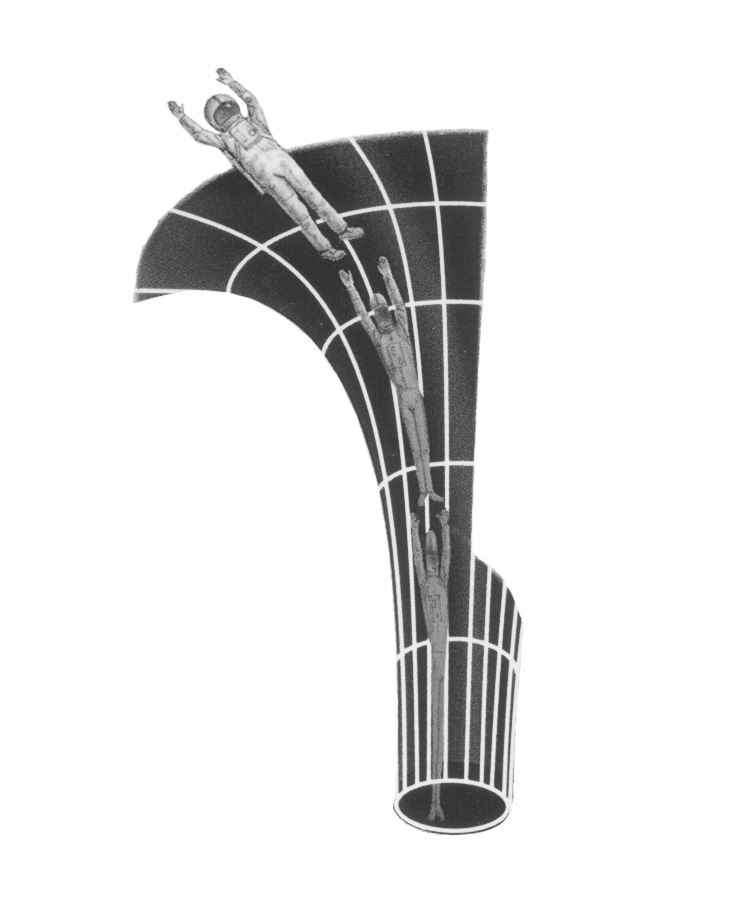
Black hole spaghettification, as envisioned by NASA.
It will hurt a lot, just at the beginning, though. It doesn’t take much stretching to kill a person, as medieval torturers discovered when they tied their victims to the rack. So you won’t suffer through most of the sparhettification experience.
Like many great horror stories, though, there’s one feature that doesn’t jibe with fact — in particular, black holes like the one Tyson described almost certainly don’t exist in reality.
Everything Spins
As far as we can tell, everything in space spins at least a little, including black holes. In that case, the black hole Tyson describes is likely mythical. There are no simple, non-spinning black holes anywhere.
Don’t get me wrong — black holes exist (even though Einstein didn’t believe in them). The Laser Interferometer Gravitational wave Observatory (LIGO) hears them colliding by the dozens every year. But every black hole ever detected spins. Every. Single. One.
Spinning black holes don’t have infinitely tiny, point-like singularities at their centers. Most astrophysicists believe they instead have ring-shaped singularities, or ringularities, that are made of infinitely dense threads of matter in a spinning hoop-like ring.
More importantly, there’s a surface surrounding the ringularity known as the inner horizon (AKA the Cauchy horizon). The inner horizon exists because the central region in a black hole is a bit like your washing machine on spin cycle. Everything freely falling inside is hurled outward toward the inner horizon.
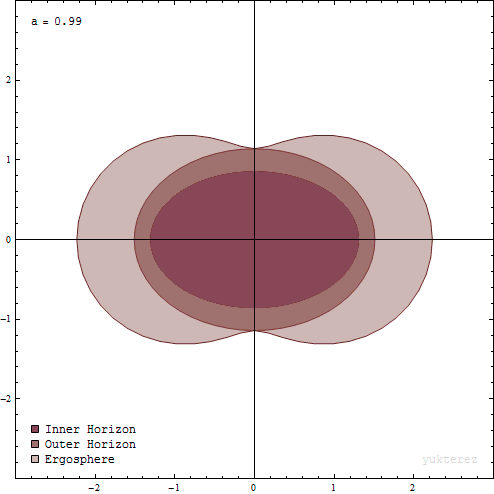
In a spinning black hole, material free-falling inside the dark colored region inside the inner horizon is hurled outward, and material outside the inner horizon falls inward. In this sketch, the central ringularity is not shown. Image courtesy of Yukterez (Simon Tyran, Vienna)
Of course, matter falling from the outside heads toward the inner horizon as well.The gravitational mass of the ringularity dragging things in and the spin hurling things out offset each other perfectly at the inner horizon. The result is an accumulation of light and debris piling up in a shell right at the inner horizon.
The combination of gravity and spin also tempers things inside the inner horizon. As legendary physicist and pioneer of the theory of spinning black holes, Roy Kerr, puts it:
. . .there will be a region between the [inner event horizon] shell and the central body where an eagle can fly if it flaps its wings hard enough.
I’m not sure why or how an eagle would cross the distances in space it would need to cover to get to a black hole. But if an eagle could fly inside a spinning black hole’s inner event horizon, a rocket ship could certainly manage it.
No Way Out
Tidal forces, like the ones that Tyson described for his mythical non-spinning black hole, can be intense inside spinning black holes as well. That would make heading toward the inner horizon uncomfortable at best, and deadly at worst, unless you pick a very large and rapidly spinning black hole.
The more massive a black hole is, the more gradually tidal forces ramp up on the way in. And the faster it spins, the larger the volume inside the inner horizon would be.
If you want to fly like an eagle inside a black hole, choose a supermassive one like Phoenix A with its outer event horizon spanning tens of times the diameter of our solar system. According to NASA, Phoenix A is probably spinning very rapidly, which means its inner horizon is comfortably spacious.
You should be prepared for a long stay if you decide to take the plunge into a black hole like Phoenix A. It’s still a black hole, after all. That means there is no chance of coming back out the same way you came in. You’ll be forever trapped by the one-way-only outer horizon.
Although you could explore the inside of Phoenix A’s inner horizon without fear of Tyson's dreaded spaghettification death, once you run out of fuel, you’ll drift to the inner event horizon to join the shell of debris. That will be the end of you . . . unless you’re clever, or very lucky.
But that’s a story for another post.
***
Sign up below to say hello or get on my list for notifications of future posts about gravity.
