
Could You Live Inside a Black Hole? (TL;DR: Yes, you could.)
Diving into a black hole doesn’t mean instant death after all, as I pointed out in my last Relatively Easy Relativity post.
But what if you wanted to move into one permanently? Could you live your whole life inside a black hole? Is it possible that there is already life inside a black hole somewhere?
According to some physicists, the answer to these questions is yes. Although that’s probably not what you’ve heard in the past.
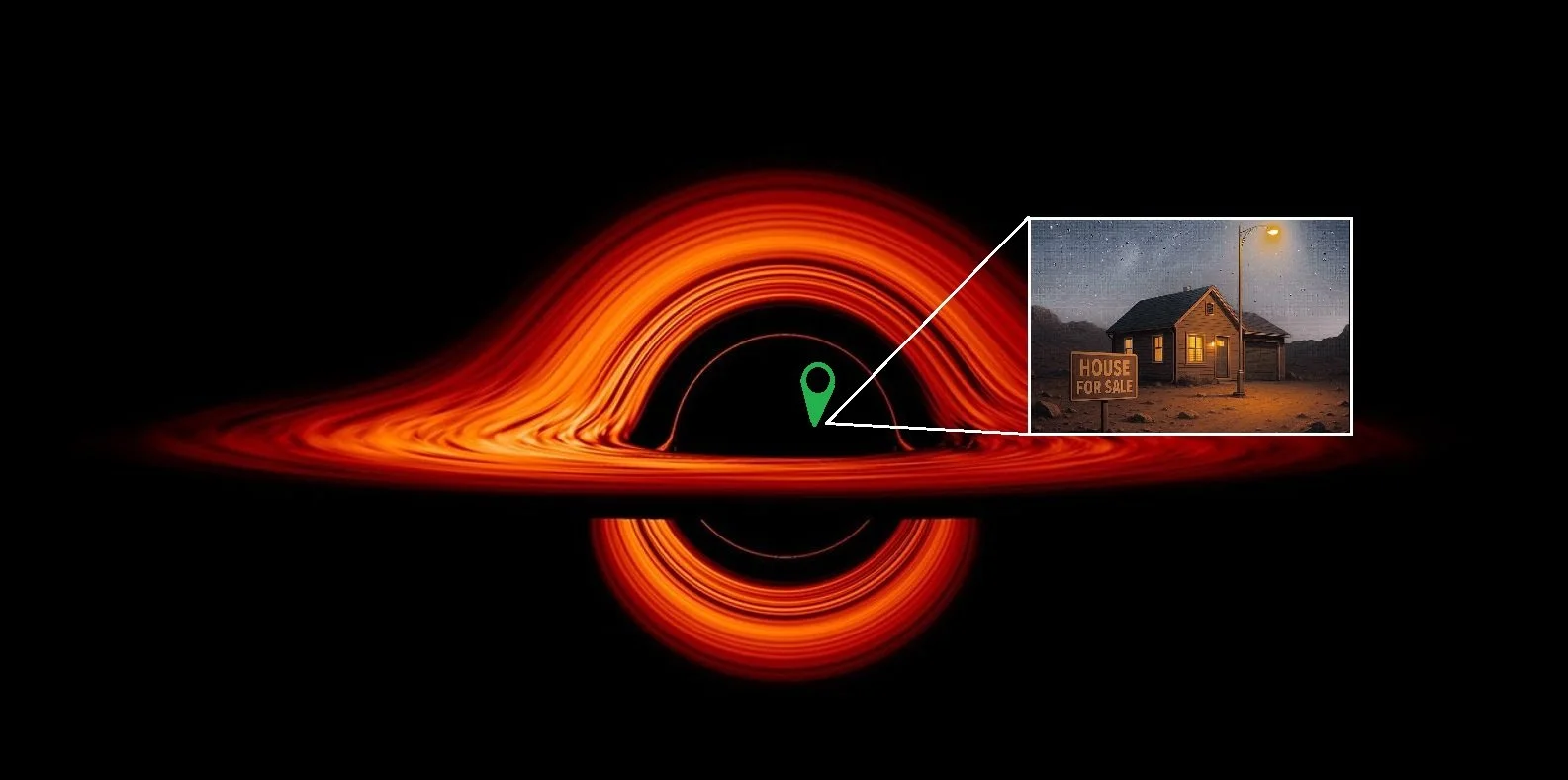
Your forever home could be in a black hole. It would be a pretty comfortable neighborhood with plenty of elbow room, provided you find real estate in a rapidly spinning, supermassive black hole.
There’s a whole cottage industry of influencers who will tell you that you’ll suffer a horrifying, spaghettifying demise as you careen toward the gravitational singularity at a black hole’s center. Astrophysicist and science communicator, Neil DeGrasse Tyson, even has a book about it!
What Tyson and other doomsayers fail to mention is that, in a real black hole, you’d never make it to the center. That’s because everything in the universe spins, as far as anyone can tell. A spinning black hole has an interior barrier that won’t let you reach its central singularity, in the event that you happen to stumble in. The barrier is called the inner horizon (in physics jargon, the Cauchy horizon).
All the black holes we’ve discovered appear to spin at least a little, whether they’re the ones we’ve seen in telescopes or those we’ve heard crashing together in gravitational wave observatories. Many of them spin a lot.
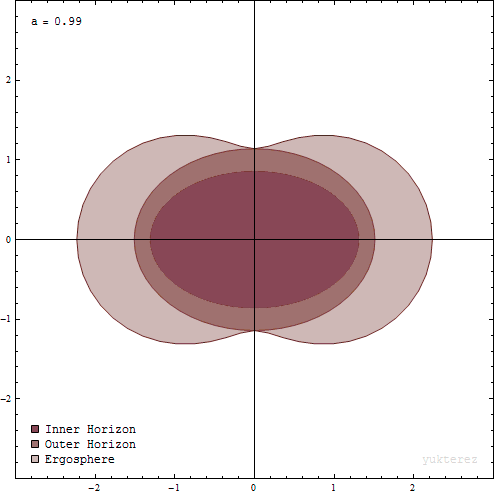
When black holes spin, they develop a structure that includes regions and surfaces that don’t exist in non-spinning black holes. Anything falling in winds up in a shell at the inner horizon. Freely falling material in the dark central region is hurled outward and ends up joining the inner horizon shell as well.
The dense mass at the center of a spinning black hole still pulls things in, but the closer you get to the center, the more the spin matters. Eventually, it gets so intense that the spin throws things outward, like a super-speedy playground carousel hurling toddlers across the yard.
The inward tug of gravity and the outward push of the spin balance out precisely at the inner horizon. That’s where you’d end up if you tripped into a real, spinning black hole.
Non-spinning black holes that could spaghettify you are cosmic Yeti; monsters that star in spooky stories, but not likely to exist in the wild.
As you head into a spinning black hole, tidal forces will still be intense, if the one you fall into is small or rotating slowly. Provided the black hole is big, though, the tidal stretching forces would be mild. And for a rapidly spinning black hole, the volume inside the inner horizon would be very large.
If you happen to take a rocket on your black hole sojourn, you could punch through the inner horizon to get a bit closer to the central singularity. The forces that come from the mass and spin offset each other enough that you’d easily jet about in the region between the inner horizon and the singularity.
According to physicist Vyacheslav Dokuchaev, you could do even better than that.
Orbits Inside a Spinning Black Hole
There are paths inner horizon where you could orbit freely, without the need for thrusters, Dokuchaev found. They’re beautiful, looping shapes that resemble the outlines of flower petals.
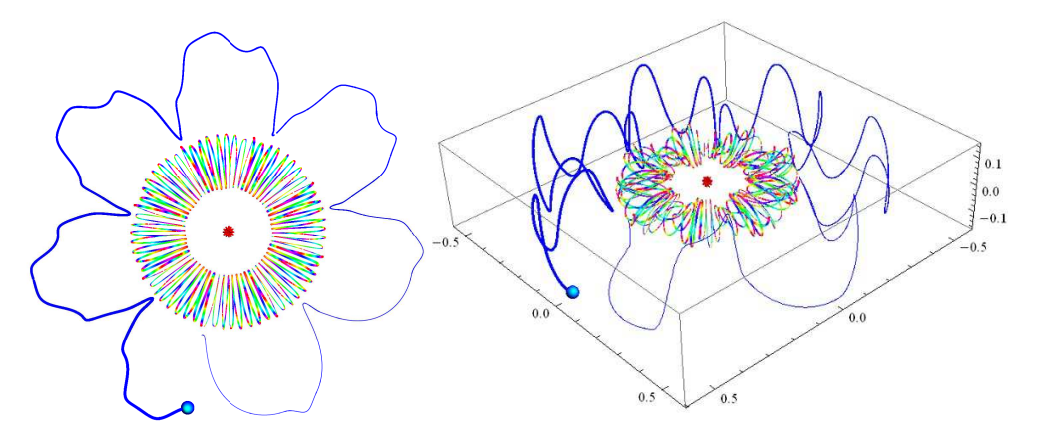
Possible orbits for objects (outer petals) and light (inner ruffle) inside the inner (Cauchy) horizon of a spinning black hole. Dokuchaev, Vyacheslav I. "Life inside black holes." Gravitation and Cosmology 18.1 (2012): 65-69.
The outer petals in this diagram are one possible orbit inside a black hole. The smaller ruffle shows where light would go into orbit. The central dot represents the black hole singularity.
Dokuchaev estimates that a black hole would have to be millions to trillions of times the mass of our sun to allow orbits with modest enough tidal forces to allow human-sized creatures to be reasonably comfortable. That places the black holes in the category of supermassives, like the one at the center of our Milky Way galaxy and probably in most of the trillions of other galaxies in the universe.
Considering that there’d be enough room to fit our entire solar system inside the largest black holes, most supermassive black holes could easily accommodate entire planets and their flowery orbits.
The lack of starlight inside a black hole leads Dokuchaev to suspect that intelligent life would have to be advanced enough to be able to harvest energy in creative ways. One possibility would be to use a bit of a host black hole’s spin energy to power things on their planet.
Once inside, of course, even an extremely advanced civilization couldn’t come back out the same way they went in, or send us any sort of message at all. That means we can’t check to see if any of the black holes in the universe are occupied.
Still, there’s at least one extremely speculative way to search for life inside black holes — first, find a wormhole. Theoretically, some black holes are actually wormhole entrances. If wormholes exist, evidence of intelligence inside a black hole in one place could be spewing out of a white hole somewhere else.
Unfortunately, there don’t seem to be any hints of white holes in our universe so far. Even if we found one, and there were signs of life tumbling out, we wouldn’t know where to look for the occupied black hole at the entrance. It could be anywhere in our universe, or maybe in a different universe altogether.
Why Would Ayone Move into a Black Hole?
This isn’t a question Dokuchaev gets into, but I can think of one reason a civilization might choose to uproot their planet and move into a black hole — to get away from jabbering neighbors like us.
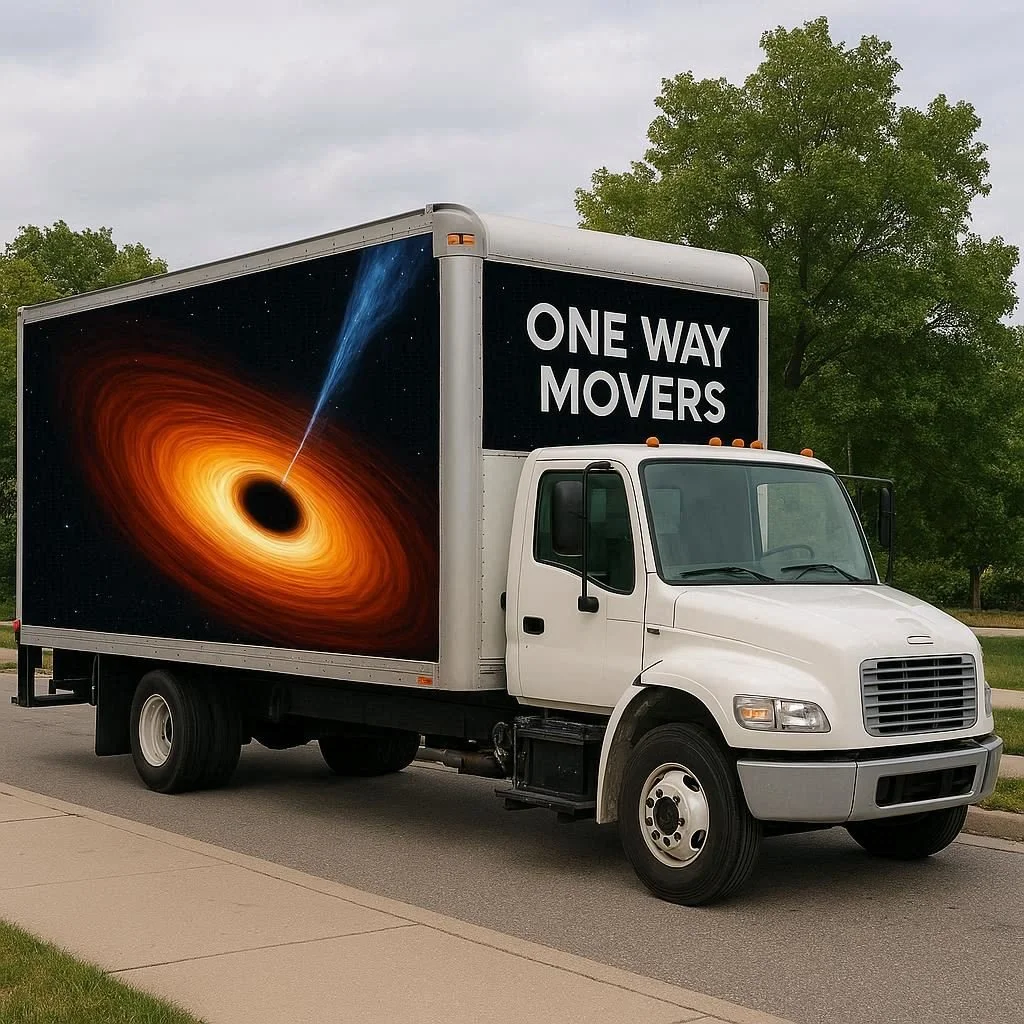
Packing up to move into a black hole is a one-way proposition, unless it’s the entrance to a wormhole that leads to a white hole somewhere else.
Alternatively, it could happen through a cosmic accident, with an occupied planet falling just the right way into a supermassive black hole.
It may even be possible for intelligent life to evolve from scratch on a planet orbiting inside a black hole. If so, it could emerge through the evolution of the most extreme of extremophiles. As long as there’s space and energy of some kind, after all, life seems to find a way.
In that case, I have to wonder — Inside one of the trillions upon trillions of black holes in the universe, is there someone wondering if there’s intelligent life somewhere out here?
