
What Happened to Hawking’s Theory of Everything?
[Adapted from Chapter 9 of Crush: Close Encounters with Gravity]
For more than 30 years, Stephen Hawking pursued the ultimate Theory of Everything. Then, abruptly, in 2009 he announced that there is no such thing, and he was OK with that.
***
“Today we still yearn to know why we are here and where we came from,” Hawking wrote in A Brief History of Time in 1988. “. . . our goal is nothing less than a complete description of the universe we live in.”
The means to the goal was a Theory of Everything that would reconcile conflicts between quantum mechanics and relativity. They are the two greatest, most successful theories in the history of physics. And yet they’e mutually incompatible in the places where they both apply — inside black holes and (probably) at the very beginning of the universe.
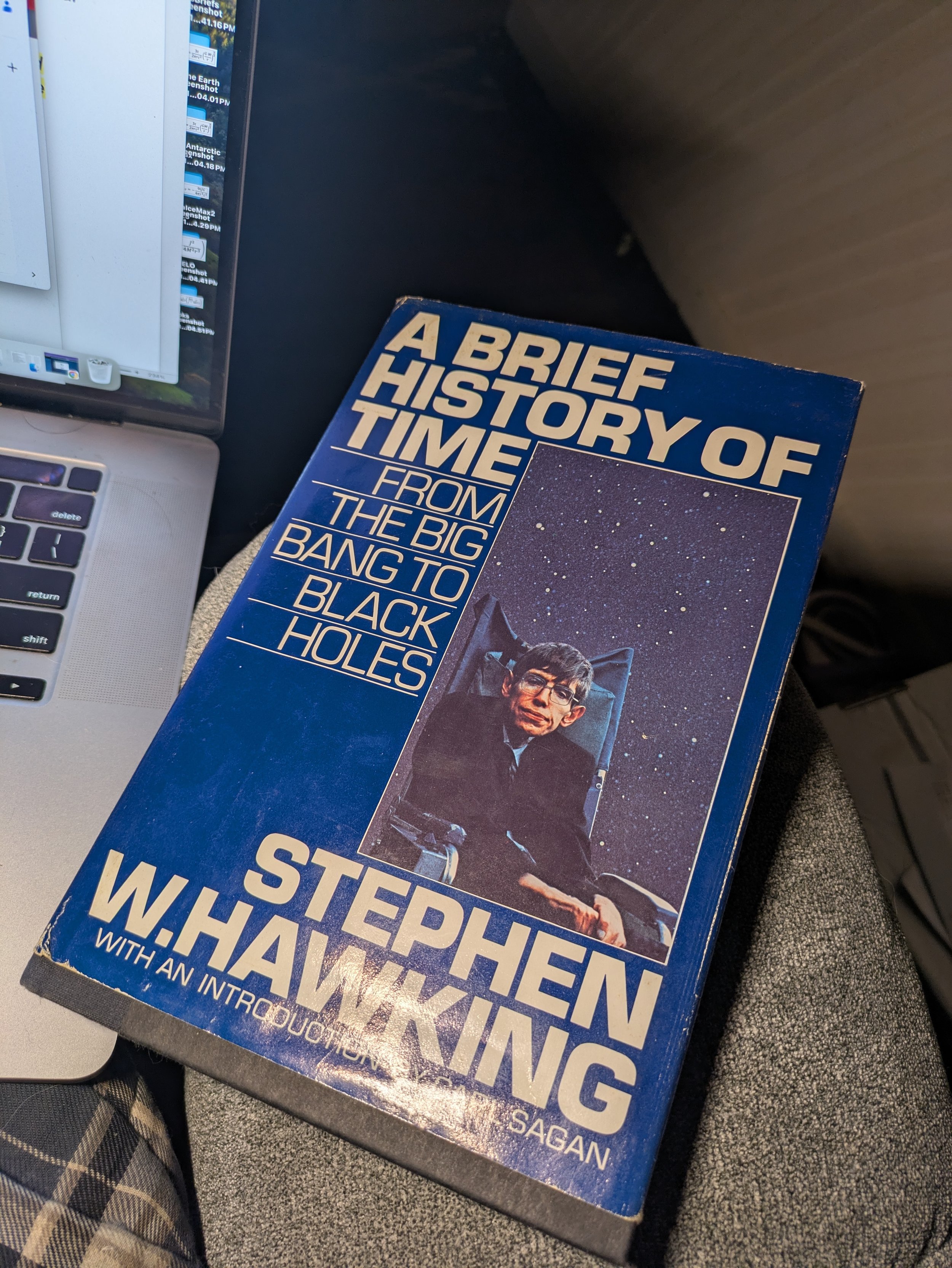
My careworn copy of Hawking’s amazing book, A brief History of Time.
Hawking had set the bar high in his Brief History, which sold more than ten million copies and was probably the best-selling popular science work since Darwin’s Origin of Species. A theory of everything has been the elusive quest of countless people, including some of the greatest scientists of the past several centuries.
Decades later, in a two-part BBC documentary of his life titled Master of the Universe, Hawking reiterated his goal.
”My life's work,” he said in his synthesized voice with its widely recognized, but oddly American, accent, “has been to unify the theories of the very large and the very small. Only then can we answer the more challenging questions. Why are we here? And where did we come from?"
Just one year later, in a 2009 lecture, Hawking threw in the towel.
“Some people will be very disappointed if there is not an ultimate theory . . . but I have changed my mind.” Hawking was 67 and had spent most of his career pursuing a Theory of Everything.
To be honest, I’m one of the disappointed people. Not so much because he failed. It’s the reason he gave that saddens me. It had nothing to do with anything he’d discovered along the way. It was due to an argument that had been around long before Hawking set out on his quest — Gödel’s incompleteness theorem.
To radically simplify the idea, Kurt Gödel realized in 1931, eleven years before Hawking’s birth, that no theory of mathematics could be both complete and be provably, totally true. Because physics is, at its heart, applied math, no physics theory can both be a Theory of Everything and be provably, totally true either.
When it comes to a complete description of the universe, Hawking concluded, it’s not that he couldn’t find a way there. It’s that there's no there there.
It seems Hawking would have saved himself a lot of time (while sadly depriving us of his landmark book) if he’d thought of that in the first place.
Hawking only had another decade left to turn to other things. He stayed busy the entire time, publishing papers and books until the end. It’s a small comfort, but at least Hawking did better than another giant of physics who went to his grave chasing a theory of everything — Albert Einstein.
Einstein spent more of his career failing to find a theory of everything than he had spent coming up with relativity in the first place.
It wouldn’t have taken Gödel’s theorem to prove Einstein was on the wrong track, though. Quantum mechanics would have done it. But Einstein didn’t believe in quantum mechanics, despite his role in founding the field.
Hawking had followed the path of most people aspiring to a Theory of Everything these days — hunting for a quantum version of relativity. Einstein instead believed that a true Theory of Everything would erase the need for quantum mechanics entirely. Bizarre quantum features, like tunneling and entanglement and wave-particle duality, he believed, were really hiding a completely sensible non-quantum theory that looks a lot like relativity.
Although Einstein was wrong, he was wrong in a way that leaves the door open for other ultimate theories. If Hawking was right, then there simply is no ultimate Theory of Everything. How on Earth could he be happy about that?
“I'm now glad that our search for understanding will never come to an end,” Hawking said, “and that we will always have the challenge of new discovery. Without it, we would stagnate.”
“Gödel’s theorem,” Hawking continued, “ensured there would always be a job for mathematicians,” and for physicsts who rely on mathematical theories.
I suppose that’s comforting for academics who need to put food on the table. Somehow, I suspect there would have been plenty to do, and lots more to learn, even if Hawking had managed his goal of “nothing less than a complete description of the universe we live in.”
Fingers crossed, someone will eventually prove that Hawking was as wrong about the impossibility of a Theory of Everything as Einstein turned out to be with his non-quantum try at it.
I just hope I’m around to see the Theory of Everything that the clever someone discovers.
***
Use the form below to get in touch or stay up to date about future Relatively Easy Relativity posts.
