
The Sad Story of the Gravitational Wave Detector on the Moon
[Adapted from Chapter 8 of Crush: Close Encounters with Gravity]
When Apollo astronauts walked on the lunar surface for the final time in 1972, they set up an instrument designed to turn the entire moon into a gravitational wave detector. The Lunar Surface Gravimeter was an ultra-sensitive seismometer that would measure minute shudders in the moon that were signs of distant cosmic catastrophies.
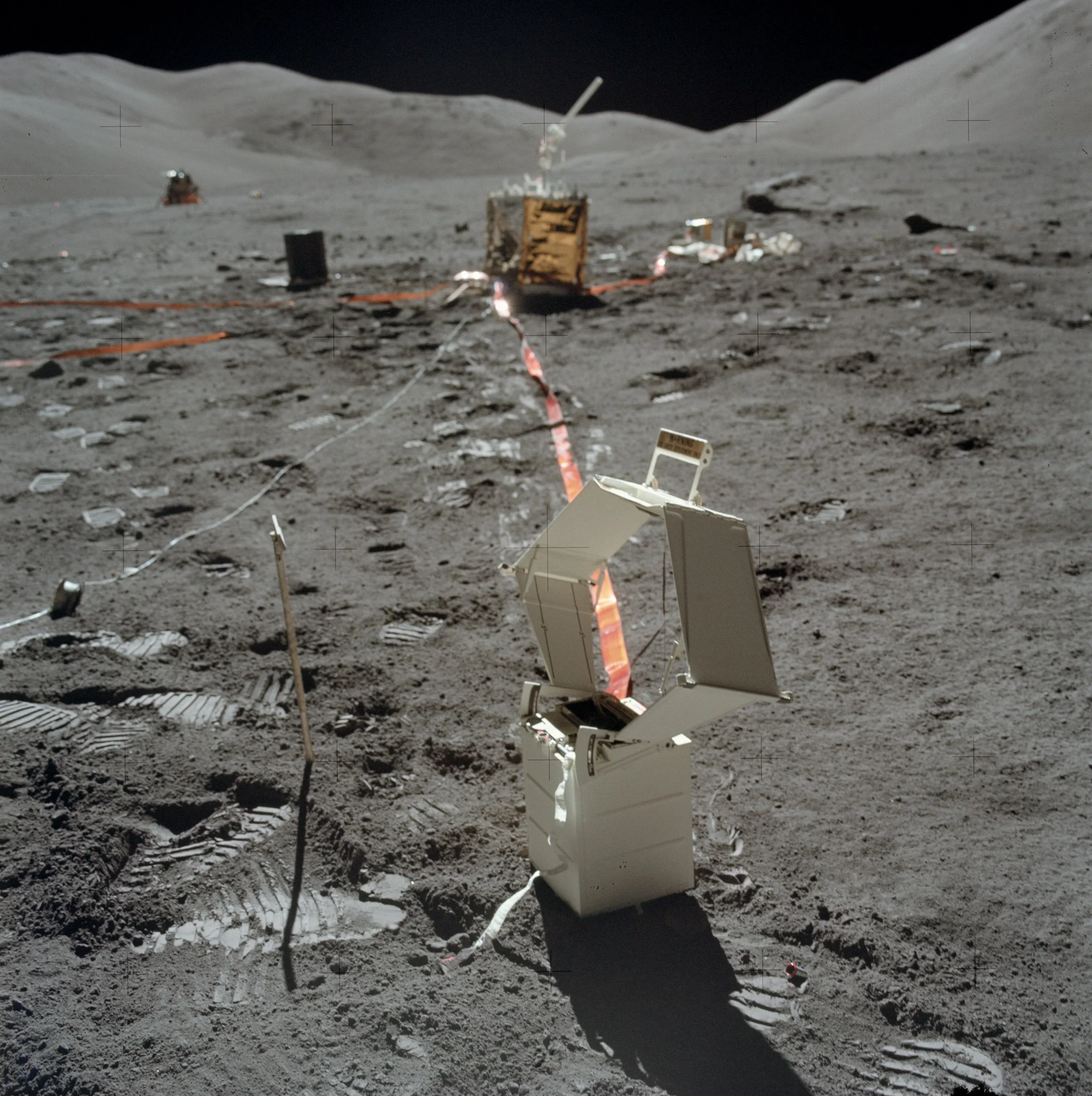
Joseph Weber’s Lunar Surface Gravimeter as installed on the moon by Apollo 17 astronauts in 1972.
If all went well, the detector would be the redemption of Joseph Weber’s tarnished reputation. He had suffered heaps of professional skepticism, public abuse, and ridicule for his widely disputed claims of having discovered gravitational waves in his terrestrial lab experiments three years prior. With the launch of Apollo 17, he had a chance to do it on the moon.
Weber had managed to convince NASA to allot him the precious space and weight aboard the last Lunar lander for an elegantly simple device that would both silence his critics and open an entirely new window on the universe.
There was one crucial impediment that stood between Weber and his scientific triumph — that was Weber himself.
The Moon as a Gravitational Wave Observatory
Crashing black hole and exploding supernovas are among the ultra-violent events that launch ripples in spacetime that alternately squeeze and stretch everything they pass as they radiate through the universe.
The energy that gravitational waves carry away from cosmic cataclysms is enormous. A collision between medium-sized black holes releases more energy than a million trillion trillion of the most powerful nuclear weapons ever detonated on Earth.
As the waves slosh through space, they alternately stretch and squeeze anything they encounter. But like the blast of a far-off cannon, their intensity fades with distance. By the time the tidal waves in spacetime make it to us from a typical black hole collision trillions of kilometers away, they’re minuscule ripples, stretching and squeezing the Earth’s diameter by the width of a proton.
It’s little wonder that the scientific community was doubtful when Weber claimed to have measured gravitational waves ringing aluminum bars only a meter or two long.
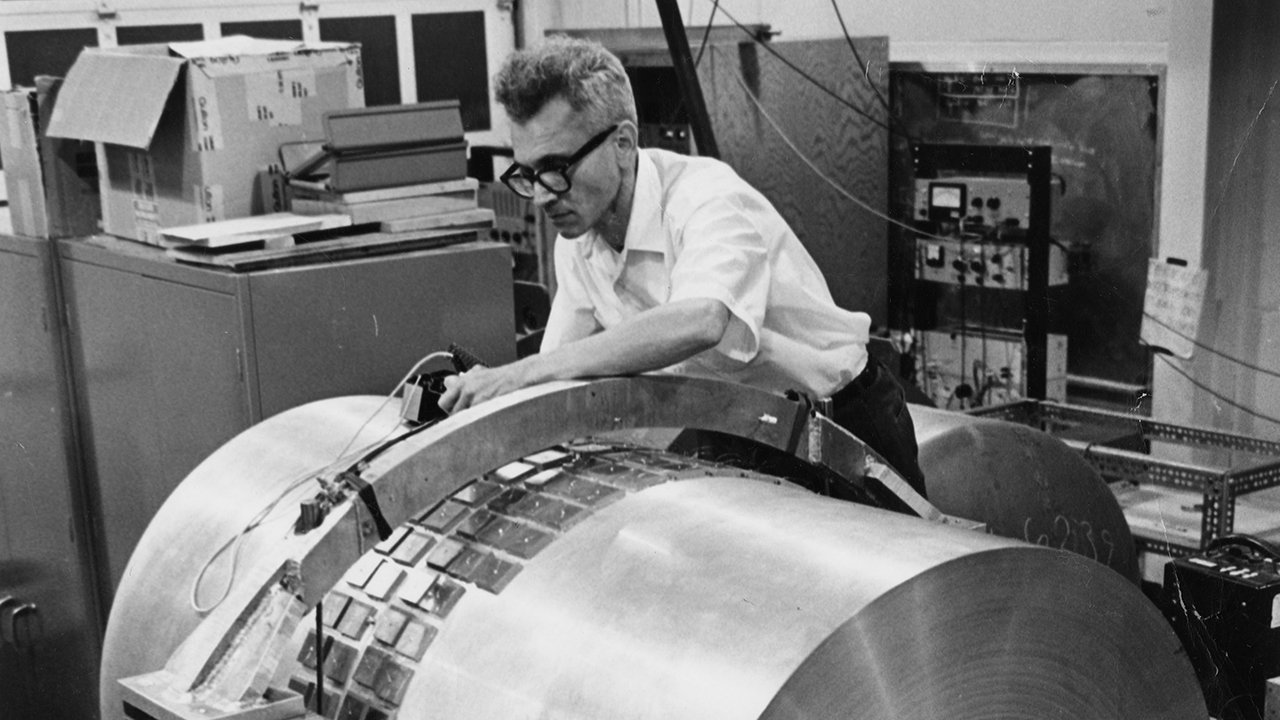
Joseph Weber installs innovative strain sensors on an aluminum bar to detect the passing of graitational waves.
Scientists these days use much longer detectors. The Laser Interferometer Gravitational wave Observatory (LIGO), which now detects black hole collisions by the dozens each year, uses laser beams to measure fluctuations in the spacing between mirrors 4 kilometers apart. Weber had much grander plans than a puny LIGO facility in 1972. By placing a seismometer on the moon, he would have a detector 3,476 kilometers across.
The Fatal Flaw in the Plan
Preparing instruments for space missions is onerous and intrusive. NASA engineers and scientists shake, cook, freeze, and spin everything that goes aboard a rocket. For experiments like Weber’s gravimeter, tests include confirming their performance under simulated moon gravity.
To replicate the conditions instruments will experience on the moon, Apollo mission engineers placed instruments, and sometimes people, on a tilted test table. Although the test subjects (mechanical or human) can’t escape the full force of Earth’s gravity, the force they experience against the tilted surface is reduced. Tilt it enough, and the force is equivalent to the gravity on the surface of the moon.
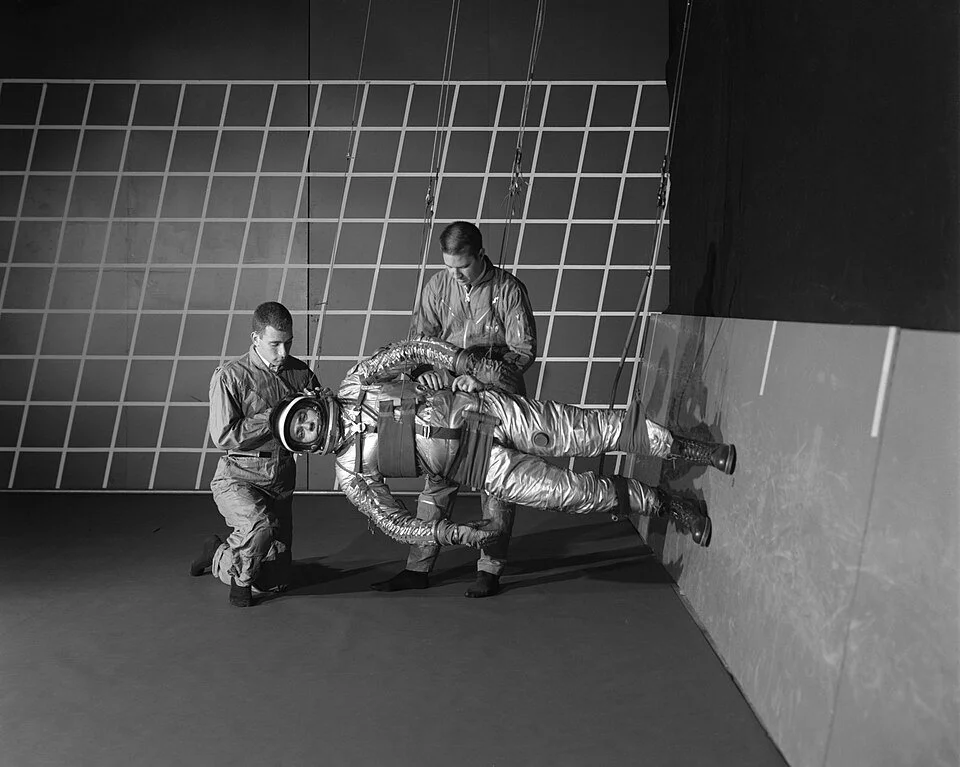
Simulating lunar gravity. By dangling astronauts or instruments at an angle, NASA technicians could simulate the effects of the moon’s gravity, which is 1/6 the gravity on Earth. ~NASA
Subjecting his Gravimeter to the tilted table test would have meant surrendering his closely-guarded proprietary design to the scrutiny of NASA staff. Weber, however, was both a maverick scientist and stubbornly secretive. He refused the tilt test and instead relied on checking the design out under the full force of Earth’s gravity, along with his research team’s calculations, to ensure the Lunar gravimeter would function as designed on the moon.
Their calculations, however, were wrong. It wasn’t until astronauts set the Lunar Surface Gravimeter up on the moon that anyone realized the error.
Weber’s moonshot gravitational wave experiment was an abysmal failure.
A Monumental Miscalculation
We may never know if Weber’s Lunar Surface Gravimeter would have revealed gravitational waves pinging the moon. Science has moved on. Observatories on Earth like LIGO, the planned Laser Interferometer Space Antenna in orbit, and even a natural gravitational wave observatory that relies on the timing of pulsars flashes, have us covered. There is probably no good reason to try Weber’s experiment on the moon again (even with proper design and testing).
Still, despite his failures to catch gravitational waves here and on the moon, Weber will go down in history as a leading pioneer of gravitational wave astronomy.
While his gravitational instruments were failures, they are serving a purpose today. A collection of his aluminum bar detectors now stands in a memorial garden at the University of Maryland, where Weber was a professor of physics.
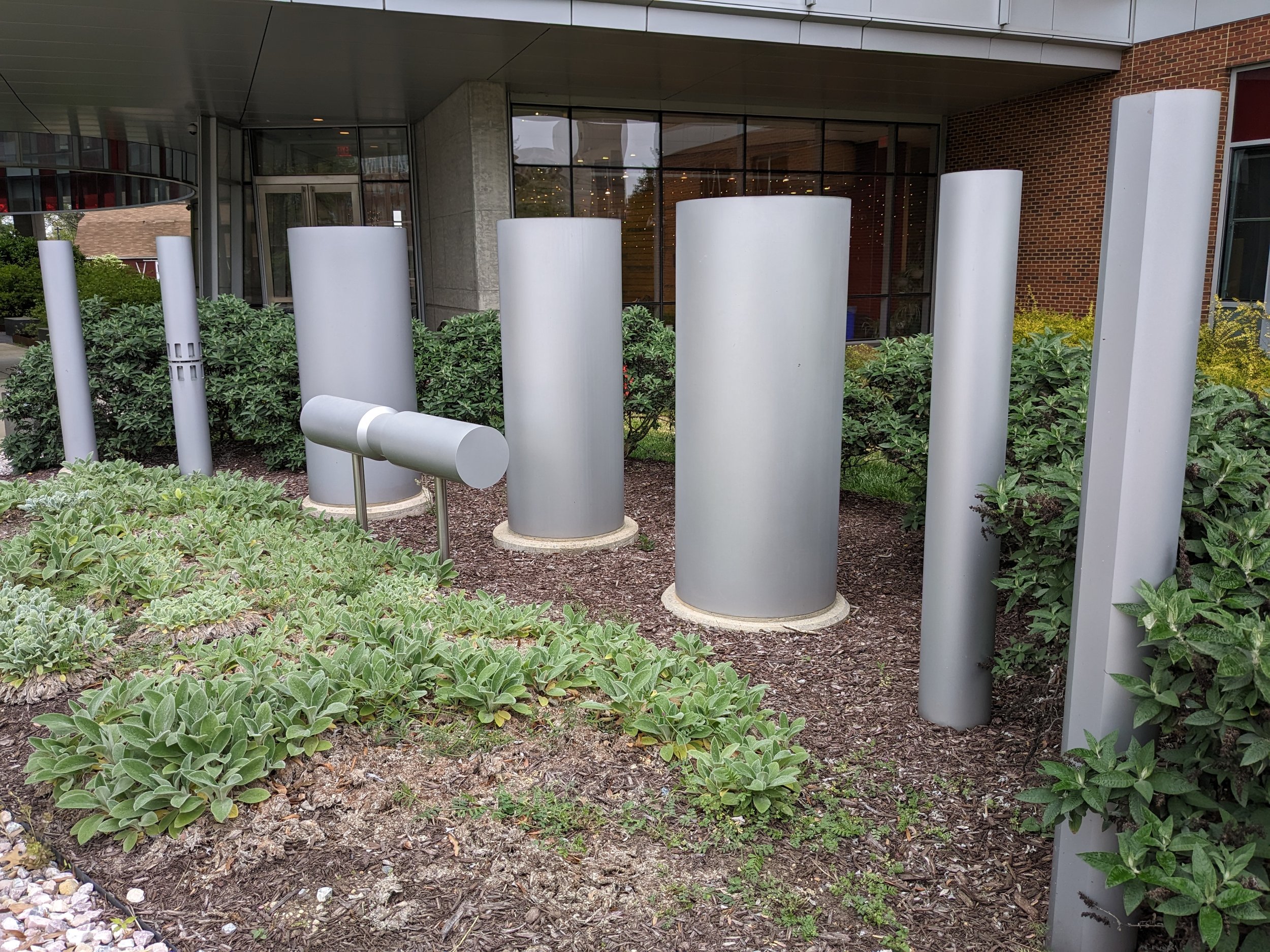
The Joseph Weber memorial garden at the University of Maryland features eight of the prototype aluminum bars that Weber hoped would ring when pinged by passing gravitational waves. ~James Riordon
The garden is a monument in honor of Weber’s contributions to gravitational wave science. The sturdy aluminum bars will be a long-lasting monument to Weber, but there’s another monument to him that will likely be around far longer.
Unless it’s hit by a meteor, the Lunar Gravimeter could remain for millions of years on the surface of the sterile and unchanging moon as a testament to Weber's persistence, vision, and tragically stubborn independence.
***
Get in touch, stay in the loop, or ask a question about this post or anything else about gravity with the form below.
